

🚀 The Ultimate List of Contractions: 100+ Contraction Words for Mastering English Grammar
If you’re aiming for fluent, natural English, mastering contractions is key. Contractions—the shortened forms of words—are an essential part of the language, particularly in spoken and informal communication. Understanding and using them correctly will significantly boost your fluency.
This guide provides the ultimate List of Contractions featuring over 100 common and informal examples. We have also corrected common grammatical misconceptions to ensure you can use every contraction on this list with confidence.
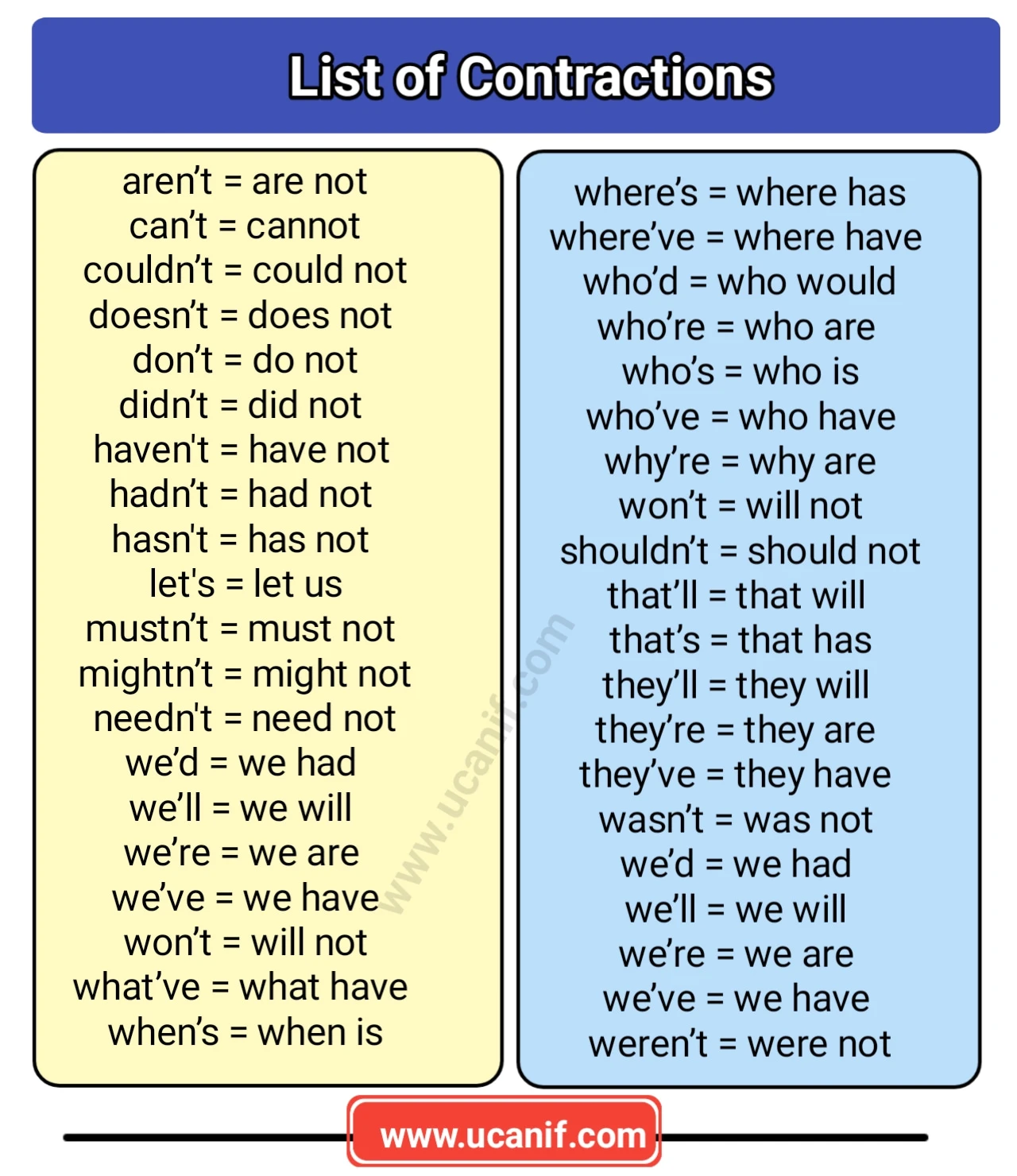
📝 Understanding Contractions: A Quick Overview
In English grammar, a contraction is formed by combining two words, omitting one or more letters, and replacing the missing letters with an Apostrophe (‘). This process creates a single, more efficient word. The detailed **list of contractions** below covers all common categories.
- “It is” becomes “It’s”
- “Do not” becomes “Don’t”
- “I will” becomes “I’ll”
Example in a Sentence:
“You should not jump if you cannot swim.”
“You shouldn’t jump if you can’t swim!”
📚 The Complete List of Contractions (Common Usage)
Here is an exhaustive list of contractions commonly used. These are acceptable in both informal speech and informal writing.
| Contraction Word | Full Form |
|---|---|
| aren’t | are not |
| can’t | cannot |
| couldn’t | could not |
| could’ve | could have |
| didn’t | did not |
| doesn’t | does not |
| don’t | do not |
| hadn’t | had not |
| hasn’t | has not |
| haven’t | have not |
| he’d | he had; he would |
| he’ll | he will; he shall |
| he’s | he is; he has |
| I’d | I had; I would |
| I’ll | I will; I shall |
| I’m | I am |
| I’ve | I have |
| isn’t | is not |
| it’ll | it shall; it will |
| it’s | it is; it has |
| let’s | let us |
| mightn’t | might not |
| mustn’t | must not |
| needn’t | need not |
| she’d | she had; she would |
| she’ll | she will; she shall |
| she’s | she is; she has |
| shouldn’t | should not |
| should’ve | should have |
| that’s | that is; that has |
| they’d | they had; they would |
| they’ll | they will; they shall |
| they’re | they are |
| they’ve | they have |
| wasn’t | was not |
| we’d | we had; we would |
| we’ll | we will |
| we’re | we are |
| we’ve | we have |
| weren’t | were not |
| what’ll | what will; what shall |
| what’s | what is; what has; what does |
| who’d | who had; who would |
| who’ll | who will; who shall |
| who’s | who is; who has |
| won’t | will not (Irregular) |
| wouldn’t | would not |
| would’ve | would have |
| you’d | you had; you would |
| you’ll | you will; you shall |
| you’re | you are |
| you’ve | you have |
🚫 Special Contractions: The Negative Forms
When forming negative contractions, the word “not” is shortened to **’n’t** and is attached directly to the auxiliary verb. Use this comprehensive list of contractions to ensure accuracy.
| Full Form | Contraction |
|---|---|
| is not | isn’t |
| are not | aren’t |
| was not | wasn’t |
| were not | weren’t |
| have not | haven’t |
| has not | hasn’t |
| had not | hadn’t |
| will not | won’t (Irregular) |
| do not | don’t |
| does not | doesn’t |
| did not | didn’t |
| cannot | can’t |
| could not | couldn’t |
| should not | shouldn’t |
| might not | mightn’t |
| must not | mustn’t |
✅ Grammar Correction Highlight: When NOT to Contract
It is important to know that you cannot contract the verb **’have’** when it functions as the main verb to indicate possession. This is a crucial rule when reviewing any **list of contractions**.
The Misconception vs. The Rule:
- ❌ Incorrect: She has brown eyes → She’s brown eyes.
- ✅ Correct (If using a contraction): She has **got** brown eyes → She’s got brown eyes.
- ✅ Correct (When ‘has’ is an auxiliary verb): She has finished her work → She’s finished her work.
🗣️ Informal (Slang) Contractions
The following forms are used almost exclusively in fast, casual speech. Although they are not formal, they are helpful additions to your list of contractions for understanding native conversations.
- wanna = want to (They wanna buy a house.)
- gonna = going to (I’m gonna call him later.)
- gotta = got to / have got a (You’ve gotta keep trying.)
- hafta = have to (We hafta ask for help.)
- hasta = has to (He hasta hire an assistant.)
- kinda = kind of (It’s kinda difficult.)
- sorta = sort of (I’m sorta tired.)
- lemme = let me (Lemme see that.)
- gimme = give me (Gimme a minute.)
🔗 Related Grammar Resources (Internal Links)
If you found this **list of contractions** helpful, you might be interested in these other essential grammar guides:
❓ Frequently Asked Questions (FAQ Section)
Should I use Contractions in Formal Writing?
No. Contractions are generally used in speech, informal emails, or blog posts. You should avoid them in academic papers, business letters, or other formal documents.
Where is the Apostrophe ( ‘ ) Placed?
The apostrophe always replaces the letter(s) that were omitted when shortening the word. For example, in ‘do not’, the ‘o’ is removed to create **don’t**.
Why is ‘Will not’ contracted to ‘Won’t’?
Won’t is an irregular contraction that comes from Old English. It is not derived from ‘will not’ but rather from the contraction of the older word **’woll not’**, which evolved into ‘won’t’ over time.
📲 Share This Post (Share Button Placeholder)
If you found this comprehensive **list of contractions** helpful, please share it with your friends!